
Passphrases 25th Word
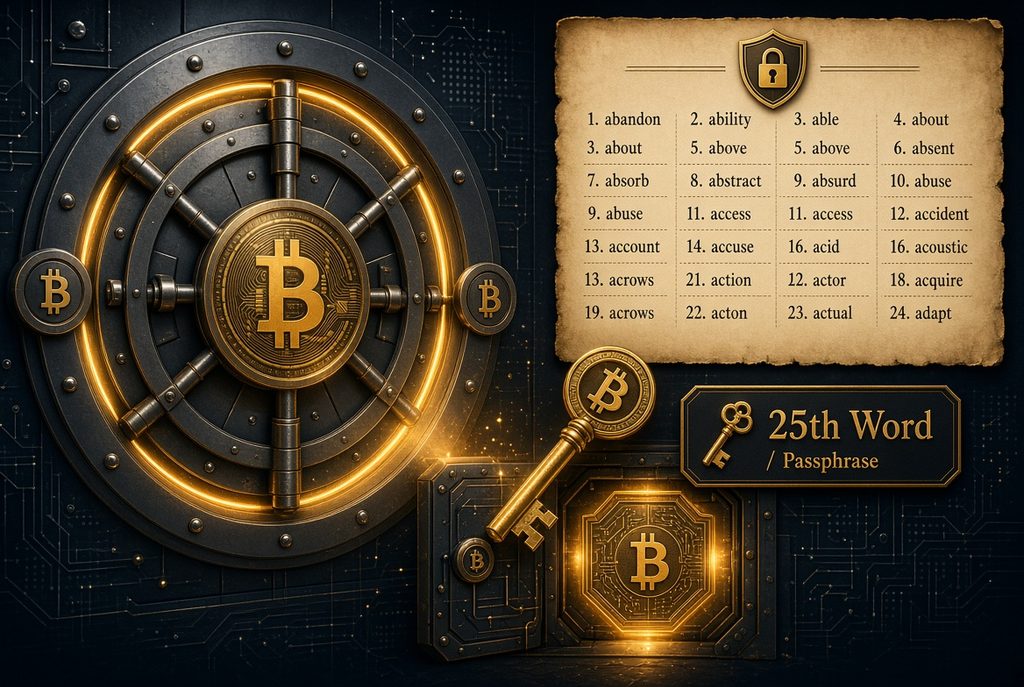
Passphrases: The 25th Word
A complete guide to the optional BIP39 passphrase — often called the “25th word” — and how it creates an extra layer of security (and risk) for your Bitcoin.
What Is a Bitcoin Seed Phrase?
Most modern Bitcoin wallets use a seed phrase (also called a recovery phrase or mnemonic). This is a sequence of 12 or 24 words drawn from a fixed list of 2,048 words defined in BIP39 (Bitcoin Improvement Proposal 39).
These words encode a large random number (entropy) plus a small checksum. When you enter the words in the correct order, your wallet can regenerate the exact same set of private keys and addresses. Anyone who has your seed phrase has full control of the Bitcoin associated with it.
What Is the “25th Word”?
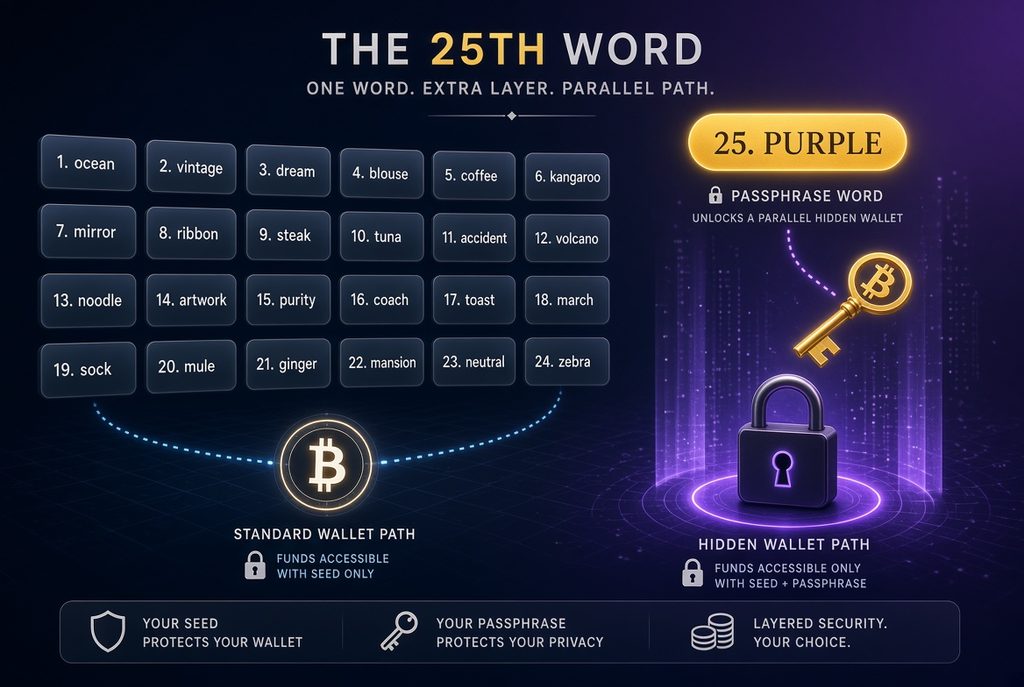
The “25th word” is the common nickname for the optional BIP39 passphrase.
It is not a 25th word from the BIP39 word list. It is an extra secret string that you choose and add on top of your 12- or 24-word seed phrase. It can be:
- A single word
- A sentence
- A mix of letters, numbers, symbols, and spaces
- Almost any UTF-8 text
The nickname exists because people usually think of a 24-word seed + one extra secret = 25 items. (Users with 12-word seeds sometimes call it the “13th word.”)
How the Passphrase Works
When your wallet creates keys from a seed phrase, it runs the words through a key-stretching function called PBKDF2-HMAC-SHA512 (2,048 iterations). The technical details are:
- The mnemonic sentence is used as the password.
- The salt is the string
"mnemonic"+ your passphrase. - The output is a 512-bit master seed.
- That master seed is then used (via BIP32) to generate all your addresses and private keys.
Key consequences:
- Empty passphrase (the default) produces one wallet.
- Any different passphrase produces a completely different wallet.
- Changing a single character, capitalization, or space creates an entirely new set of addresses.
- There is no “wrong” passphrase. Every possible string opens a valid wallet (almost always empty if you haven’t used it before).
This is by design. The BIP39 specification explicitly notes that this provides plausible deniability.
Why People Use a Passphrase
- Protection if the seed phrase is compromised
If someone finds, photographs, or steals your written seed phrase, they still cannot access the funds protected by the passphrase. They only open the “standard” wallet that uses the empty passphrase. - Hidden wallets / plausible deniability
You can keep a small amount of Bitcoin in the standard (no-passphrase) wallet as a decoy. The majority of your funds can sit in a hidden wallet that only opens when the correct passphrase is entered. This is useful in physical coercion scenarios (sometimes called a “$5 wrench attack”). - Multiple wallets from one seed
You can create as many separate wallets as you want from the same seed phrase simply by using different passphrases.
Most major hardware wallets (Jade, Keystone, BitBox, etc.) support the BIP39 passphrase feature.
Critical Risks and Warnings
The passphrase is powerful, but it is also unforgiving.
- If you forget or lose the passphrase, the Bitcoin is gone forever.
Even if you still have the full 12/24-word seed phrase, the funds in the passphrase-protected wallet cannot be recovered. There is no reset, no support ticket, and no recovery process. - No error message for a wrong passphrase.
Entering an incorrect passphrase (including a simple typo, wrong capitalization, or extra space) does not produce an error. It simply opens a different, empty wallet. This can make troubleshooting extremely difficult. - Human error is common.
Case sensitivity, spaces, punctuation, and keyboard layout differences have locked people out of significant amounts of Bitcoin. - The passphrase must be stored separately.
If you store the passphrase with the seed phrase, you lose most of the security benefit. - Not stored on the device.
Hardware wallets generally do not store the passphrase. You must enter it every time you want to access the hidden wallet (or use a temporary session feature some devices offer).
Best Practices
- Use a passphrase only if you fully understand the risks and have a reliable way to back it up separately from the seed.
- Prefer a long, unique passphrase (a memorable sentence or high-entropy string). Short dictionary words are weaker against targeted attacks if an attacker already has the seed.
- Store the passphrase on a different medium and in a different location from the seed phrase (e.g., different metal backup plate, different safe, different geographic location).
- Always test recovery before sending significant funds. Restore the wallet on a second device using both the seed and passphrase and confirm you see the same addresses.
- Start with a small test amount.
- Consider whether a passphrase is the right tool for your situation. For some users, a well-secured seed + good operational security (or a multisig setup) may be preferable.
- Document the exact passphrase carefully (including capitalization and spaces) and protect that documentation.
Common Misconceptions
| Misconception | Reality |
|---|---|
| The 25th word is just another BIP39 word | No. It can be any string and is not checked against the word list or checksum. |
| The wallet will warn you if the passphrase is wrong | No. It opens a different wallet. |
| The passphrase is stored on the hardware wallet | Usually not. You re-enter it when needed. |
| It replaces the need to protect the seed phrase | No. Both secrets are required. Compromising either reduces security. |
| A short passphrase is fine because the seed is already strong | The passphrase’s value comes from being unknown to an attacker who has the seed. Weak passphrases can be brute-forced. |
Summary
The BIP39 passphrase (the “25th word”) is an optional extra secret that transforms one seed phrase into an unlimited number of completely separate wallets. It is one of the strongest tools available for protecting against physical theft of a seed phrase and for creating plausible deniability. At the same time, it introduces a permanent, irreversible risk of total loss if the passphrase is forgotten or mistyped.
It is a powerful feature best used by people who understand exactly how it works and who have a robust, separate backup strategy for the passphrase itself.
Disclaimer: This page is for educational purposes only and does not constitute financial, security, or legal advice. Self-custody of Bitcoin carries significant risks. Always verify information, test your setup thoroughly with small amounts, and consider your own threat model before using advanced features like a BIP39 passphrase. You are solely responsible for the security of your keys and funds.